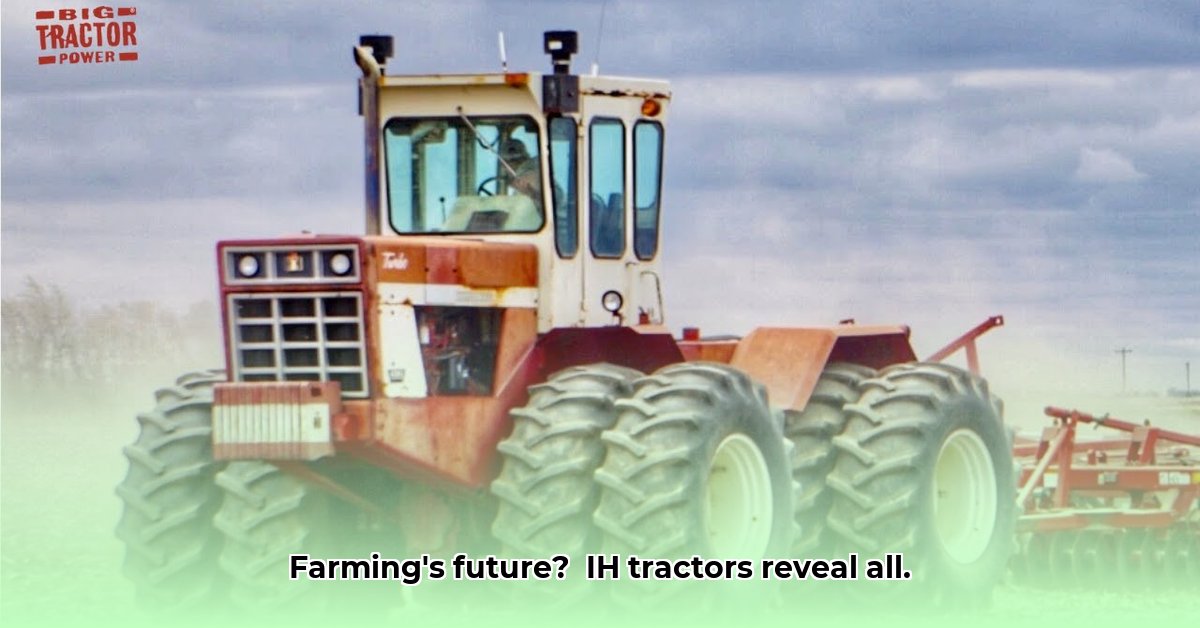
The rumble of an International Harvester (IH) tractor—a sound synonymous with American agricultural history—tells a complex story. It's a narrative interwoven with ingenious inventions, fluctuating fuel consumption, and the enduring question of their true contribution to sustainable farming. This isn't simply a historical recounting; we'll delve into how IH tractors reshaped agriculture, exploring both their triumphs and their environmental consequences. We'll trace their evolution, examining fuel efficiency across different models and the ongoing legacy of Case IH, the entity that inherited IH's complex environmental responsibility. For more details on specific models, see this IH tractor resource.
IH Tractors: A Revolution in the Fields
The story of International Harvester, particularly its iconic Farmall line, is inextricably linked to the transformation of American agriculture. These machines weren't merely tools; they were catalysts for unprecedented productivity, enabling farmers to cultivate larger fields and significantly increase crop yields. But this remarkable surge in output came at a cost. Did the increased efficiency outweigh the environmental impact? This question remains central, particularly within the context of today's focus on environmentally conscious farming practices.
Early Models: Power at a Price
Early IH tractors, while revolutionary in their power and capability, weren't designed with environmental sensitivity as a priority. Their fuel consumption was substantial, and their considerable weight compacted soil, potentially leading to long-term land degradation. The primary focus then was on maximizing output and speed – sustainability wasn't a primary concern. While technological advancements made these machines more efficient over time, the environmental trade-offs need careful consideration. Did farmers fully comprehend the implications? It's a question that requires nuanced historical analysis.
Incremental Improvements: A Move Towards Sustainability?
The IH narrative doesn't end with early models. Subsequent designs reflected a growing awareness of resource use. Technological advancements, such as improved fuel injection systems and onboard computer monitoring, suggest a gradual shift towards greater efficiency. Features like the Sentry system allowed farmers to fine-tune operations, potentially reducing fuel waste and maximizing output. While not explicitly marketed as "green," these upgrades represent steps towards more sustainable farming practices. However, these improvements need to be contextualized within the increasing scale of farming operations that these tractors facilitated.
The Need for Comprehensive Analysis
The impact of IH tractors on farming is undeniable. However, a comprehensive understanding of their long-term environmental consequences necessitates in-depth data analysis. We need rigorous comparisons of fuel efficiency across various models and periods. Moreover, detailed life cycle assessments (LCAs) are crucial for understanding the overall environmental impact, from manufacturing and operation to eventual disposal. Such analyses can clearly quantify the trade-offs between productivity gains and resource consumption.
Case IH: A Legacy Forged in Progress and Environmental Responsibility
The merger of International Harvester with Case created Case IH, inheriting both a legacy of engineering prowess and a complex history regarding environmental responsibility. Case IH now shoulders the considerable challenge of driving the evolution of sustainable farming technology, leveraging its predecessor’s foundation to pioneer environmentally responsible agricultural practices. This ongoing commitment to innovation is crucial for the future of sustainable agriculture.
A Collaborative Pathway: The Future of Sustainable Agriculture
Improving fuel efficiency and minimizing environmental impact are paramount. A transition towards more sustainable manufacturing materials is also essential. Collaboration between scientists, manufacturers, and policymakers is indispensable for driving innovation and fostering the adoption of ecologically responsible practices. Government incentives and policies supporting sustainable farming equipment are crucial steps in this direction.
Actionable Intelligence: A Roadmap for a Greener Future
Progress towards sustainable agriculture requires a multifaceted approach, involving various stakeholders. Below are actionable steps that highlight clear goals and timelines:
- Case IH/CNH Industrial: Conduct comprehensive analysis of historical fuel use and machine lifespan data (0-1 year) and design tractors with significantly improved fuel efficiency and substantially reduced emissions (3-5 years).
- Farmers: Conduct thorough comparisons of long-term costs for older and newer tractors (0-1 year) and invest in precision agriculture techniques to optimize resource utilization and minimize waste (3-5 years).
- Researchers: Conduct LCAs on various IH tractor models (0-1 year) and develop innovative methods for assessing the environmental impact of agricultural machinery (3-5 years).
- Governments/NGOs: Offer financial incentives to encourage farmers to adopt sustainable technologies (0-1 year) and implement policies that promote the use of sustainable farm equipment and practices (3-5 years).
The legacy of IH tractors is multifaceted. Their early contributions revolutionized farming, yet a complete understanding of their environmental impact mandates further research. The path to sustainable agriculture demands that we learn from the past, combining technological advancement with a deep commitment to responsible environmental stewardship. Continued research promises to refine our knowledge of the dynamic interplay between agricultural mechanization and environmental sustainability.